In the world of industrial lighting, understanding "what is the difference between UFO high bay and linear high bay" is crucial. As lighting expert John Smith states, "Choosing the right high bay light can significantly impact both performance and energy efficiency."
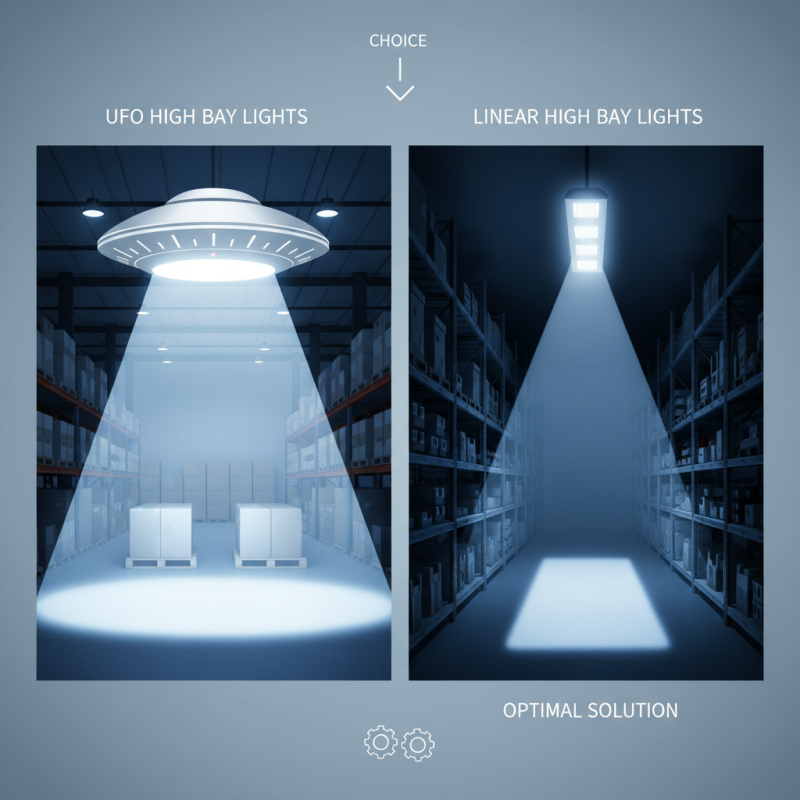
UFO high bay lights feature a circular design, ideal for large spaces like warehouses. Their round shape allows for better distribution of light, reducing shadows. Conversely, linear high bay lights have a long, sleek design that suits narrow aisles or areas needing focused illumination. This distinction plays a significant role in selecting the appropriate lighting for specific environments.
Many industries face the challenge of balancing aesthetics and functionality. UFO lights may enhance the visual appeal of a high ceiling area. Meanwhile, linear lights can provide directed lighting that enhances safety in workspaces. Each type has its strengths and weaknesses. It’s essential to consider the layout and purpose of the space. Reflecting on these differences will ensure optimal lighting solutions for your facility.
Definition of UFO High Bay Lights and Their Applications
UFO high bay lights are essential in industrial and commercial spaces. Their unique shape allows for efficient air circulation and heat dissipation. These lights emit bright, focused illumination, making them ideal for warehouses, factories, and gymnasiums. They are often used in spaces with high ceilings, providing consistent lighting across large areas. The lumen output is impressive, creating a safe and productive environment.
Consider energy efficiency when selecting UFO lights. They typically offer longer lifespans and lower energy consumption compared to traditional lighting. Installing motion sensors can further enhance energy savings. Make sure to choose the right wattage to meet your space's specific lighting needs.
Linear high bay lights differ in design, providing a more elongated lighting profile. They are suitable for applications such as assembly lines or long aisles. Their linear nature allows for widespread illumination with fewer fixtures. Assess your venue to determine which system benefits your operations most effectively. An evaluation of both light types can guide your selection.
Comparison of UFO High Bay and Linear High Bay Lights
In this chart, we compare the UFO High Bay and Linear High Bay lights based on two crucial metrics: Lumens Output and Energy Consumption. The UFO High Bay lights offer a higher lumen output but consume more energy, while the Linear High Bay lights provide a lower lumen output with better energy efficiency.
Definition of Linear High Bay Lights and Their Applications
Linear high bay lights are designed for spaces with high ceilings. They emit bright, even light, making them ideal for warehouses and manufacturing areas. These fixtures often use LED technology. This allows for energy efficiency and a longer lifespan.
Applications for linear high bay lights are varied. They are commonly found in industrial settings, where visibility is crucial. Additionally, they are useful in large commercial spaces like retail stores. Proper installation ensures optimal light coverage across vast areas.
However, some challenges remain. It's crucial to assess the specific lighting needs of a space. Over-illumination can lead to glare, making tasks harder. Regular maintenance is necessary to keep lights functioning optimally. Understanding these factors helps in making informed choices for effective lighting solutions.
Difference Between UFO High Bay and Linear High Bay Light
| Feature |
UFO High Bay Light |
Linear High Bay Light |
| Design |
Round, compact structure |
Rectangular, slim profile |
| Light Distribution |
360-degree beam angle |
Directional light output |
| Typical Wattage |
100W to 300W |
50W to 200W |
| Installation Height |
15 to 30 feet |
10 to 20 feet |
| Applications |
Warehouses, factories, gyms |
Retail, commercial spaces, workshops |
| Energy Efficiency |
Highly efficient, lower operating costs |
Good efficiency, consumes less power |
Key Differences in Design and Structure Between the Two Types
When comparing UFO high bay and linear high bay lights, design and structure play pivotal roles. UFO lights are compact and circular, resembling a flying saucer. This unique shape allows for effective light distribution in large spaces, such as warehouses. They often utilize LED technology for energy efficiency, creating a bright, focused beam.
On the other hand, linear high bay lights have an elongated, rectangular shape. This design makes them ideal for long, narrow spaces. They can produce a more even light spread across wider areas, minimizing shadows. The structure can accommodate multiple rows, enhancing overall illumination in extensive environments.
Choosing the right type of high bay lighting depends on the space's layout. Both options have their benefits and drawbacks. UFO lights might excel in quick installation but could fall short in ambient light distribution. Linear lights can cover more ground but require precise mounting to ensure effectiveness. Understanding these differences can guide informed decisions in lighting applications.
Energy Efficiency and Performance Comparison of UFO vs. Linear
When comparing UFO high bay lights with linear high bay lights,
energy efficiency stands out as a key factor.
UFO lights often have an efficacy of around 100-150 lumens per watt,
while linear options typically range from 80 to 120 lumens per watt. This difference translates into
significant energy savings over time, particularly in large spaces
such as warehouses or manufacturing plants. An energy-efficient lighting solution can substantially reduce
operational costs.
Moreover, the performance of these lights varies based on their design and application.
UFO high bays provide focused illumination and are ideal for areas with high ceilings, such as
distribution centers. They can achieve a higher light output due to their compact design.
In contrast, linear high bays offer a wider beam angle, distributing light
more evenly across large areas. Facilities might need to assess their specific requirements.
In terms of longevity, many
UFO lights boast a lifespan of up to 50,000 hours, while linear models tend to last around
30,000 hours. However, the installation and maintenance costs can be higher for
UFO lights, which may require specialized fixtures. Each option has its trade-offs, making
informed choices crucial for maximizing both performance and energy efficiency.
Balancing these factors leads to optimal usage in various settings, highlighting the importance of tailored
lighting solutions.
Installation Considerations and Suitability for Different Environments
When comparing UFO high bay lights and linear high bay lights, installation considerations play a crucial role. UFO lights, which have a round shape, are often mounted directly to ceilings in warehouses or large spaces. Their design allows for flexible installation with a focus on maximizing vertical light distribution. In contrast, linear high bay lights are more suitable for long, narrow areas, like production lines or aisles. Their elongated form provides even illumination across larger surfaces.
Choosing the right fixture depends on the environment. UFO high bays excel in spaces with high ceilings, ensuring light reaches the floor effectively. Conversely, if you're dealing with low ceilings, a linear light may be a better fit. Consider how the layout of the room can influence light distribution and visibility.
Tips: Always assess the height of the ceiling before installation. Measure the area carefully to determine the best spacing between fixtures. Experimenting with a few positions can lead to the ideal solution. Remember, not all fixtures suit every environment, so flexibility in planning is key. Proper placement can significantly enhance visibility and safety in workspaces.
FAQS
: Linear high bay lights are designed for high ceilings, providing bright, even illumination in large spaces.
They are commonly found in warehouses and manufacturing areas, as well as large retail spaces.
Many linear high bay lights utilize LED technology for energy efficiency and extended lifespan.
UFO lights are compact and circular, while linear lights are elongated and rectangular.
UFO lights provide focused illumination, while linear lights offer a more even spread, minimizing shadows.
Evaluating specific lighting needs is crucial to avoid over-illumination and glare issues.
UFO lights have higher efficacy, offering better energy savings compared to linear options over time.
UFO lights can last up to 50,000 hours, while linear lights typically last around 30,000 hours.
Yes, regular maintenance is needed for optimal performance, particularly for UFO lights with specialized fixtures.
UFO lights may have higher installation and maintenance costs, requiring a careful assessment of budget and needs.
Conclusion
When considering industrial lighting solutions, understanding what is the difference between UFO high bay and linear high bay lights is crucial. UFO high bay lights are typically characterized by their round, disk-like design, making them suitable for high-ceiling environments such as warehouses and manufacturing facilities. They provide focused illumination and are often used in spaces requiring high lumen output. In contrast, linear high bay lights have an elongated shape, making them ideal for long aisles or wide open spaces, providing better light distribution over larger areas.
The design and structure differences between these two types of lights also influence their installation and energy efficiency. UFO lights are often easier to install in clustered arrangements, while linear lights are more versatile for various configurations. Additionally, performance comparisons indicate that linear high bays may offer better energy efficiency in certain setups. Ultimately, choosing between UFO and linear high bays depends on the specific application and environmental requirements of the space being illuminated.

