Choosing the right heat sink can determine whether an LED corn lamp stays bright or fades early. This article explains why choose aluminum heat sinks for led corn lamps, focusing on thermal performance, weight, cost, and installation conditions. Aluminum conducts heat efficiently and spreads it across thin fins. Those fins increase surface area around the lamp body. Air can then remove heat more effectively.
Dr. James R. Brodrick, a recognized solid-state-lighting specialist, has emphasized a practical principle: “Thermal management is central to LED reliability.” His point remains relevant for corn lamps used in workshops, warehouses, garages, and street fixtures. A properly sized aluminum heat sink helps control junction temperature, especially when airflow is limited. It also reduces stress on LED chips, drivers, and solder connections. Small details matter. A rough mounting surface, loose contact, or blocked fin spacing can weaken the entire thermal path.
Still, aluminum is not a magic solution. I have seen oversized heat sinks installed inside cramped fixtures, where trapped air reduced their real benefit. That mistake deserves attention. Buyers should compare thermal resistance, fin design, base thickness, surface treatment, and lamp wattage. Outdoor users should also consider corrosion, dust, moisture, and mounting direction. Lightweight aluminum simplifies handling, but very thin material may deform during installation. The best choice balances conductivity with mechanical strength. It should match the lamp’s actual heat load, not only its advertised wattage. Reliable selection requires measurements, manufacturer data, and honest consideration of the fixture’s environment.
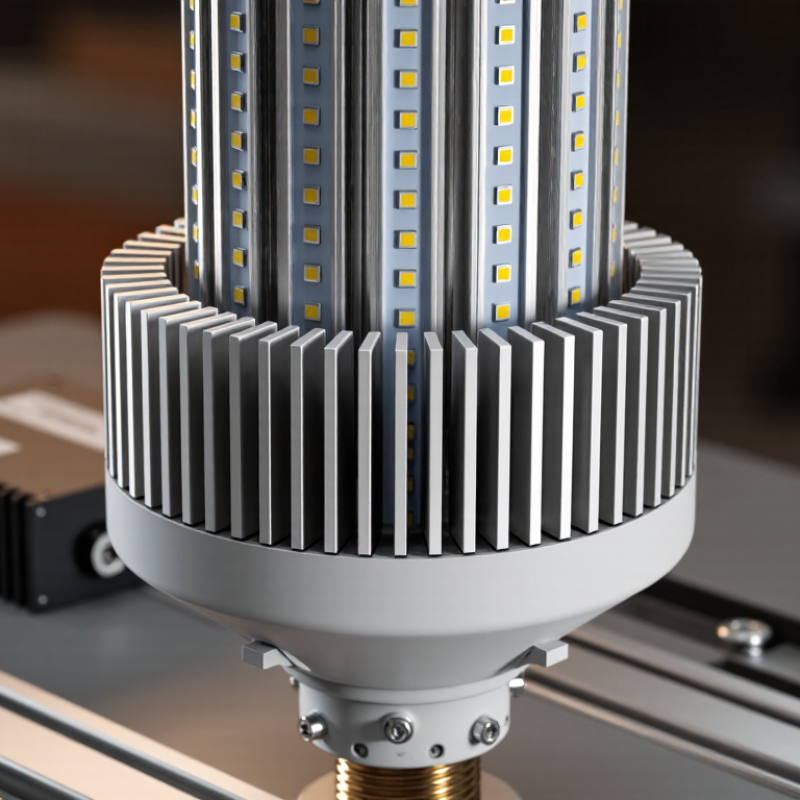
LED Corn Lamp Heat Sink Requirements
LED Corn Lamp Heat Sink Requirements
A corn lamp packs many LED packages around a compact core, leaving little room for heat to escape. Its aluminum heat sink must move heat from the board into surrounding air, not merely look substantial. Check the base interface, fin spacing, and total surface area. A thin layer of thermal interface material can help, but uneven contact or a loose fit can create hot spots near the driver or LED board. Small details matter.
The IES LM-80-20 method evaluates LED source lumen maintenance over time; testing runs for at least 6,000 hours, with longer testing recommended. That is useful evidence, but it does not prove a complete lamp will last equally long. The U.S. Department of Energy’s guidance on LED luminaire lifetime also stresses that operating temperature affects component life and performance. Keep the claimed data in context. In practice, measure temperatures at the board and driver after the lamp reaches steady operation inside its intended fixture. A hot enclosed socket may behave very differently from an open test bench. Fins need airflow, too. More metal alone is not a guarantee; tight fin gaps can trap dust and restrict convection. I would specify the lamp’s ambient-temperature range, mounting orientation, and thermal test conditions before comparing sink designs. A little uncertainty remains unless the assembled lamp is tested under real installation conditions.
Key Factors in Choosing Aluminum Heat Sink Materials
Aluminum Heat Sink Materials for LED Corn Lamps
Choosing an aluminum heat sink material begins with the lamp’s heat load, available space, and operating environment. Aluminum alloys conduct heat well while keeping the assembly light. For many corn lamps, 6063 aluminum is practical because it extrudes into fins with smooth, consistent surfaces. That shape matters: narrow, evenly spaced fins expose more area to moving air.
Not all aluminum performs the same way. Higher thermal conductivity can help spread heat from the LED board, but alloy choice also affects strength, machinability, and cost. A thin fin may cool effectively in open air, yet bend during handling. In a crowded fixture, even good fins can struggle because airflow is restricted. Check the heat sink’s temperature under realistic conditions, not only in a cool workshop.
Surface treatment deserves attention, too. Anodizing can improve corrosion resistance and create a durable finish, though it may slightly affect heat transfer at the surface. The difference is often less important than the sink’s geometry and contact with the LED board. Use a flat mounting face and an appropriate thermal interface material; small gaps can trap heat. There is no perfect alloy for every lamp. A heavier, more expensive part is not automatically better, and test results may surprise you. Measure temperatures after the lamp reaches steady operation.
How to Match Heat Sink Size with LED Power
How to Choose Aluminum Heat Sinks for LED Corn Lamps
Matching an aluminum heat sink to LED power starts with heat, not wattage alone. A 30-watt lamp does not always need the same sink as another 30-watt design. Driver losses, LED efficiency, and the lamp’s enclosed shape all affect how much heat reaches the sink. Check the LED maker’s thermal data, especially the maximum junction temperature and recommended thermal path. Then consider the local ambient temperature. A lamp operating in a warm, poorly ventilated fixture needs more cooling capacity than one exposed to open air.
Heat sink size is often compared using thermal resistance, measured in degrees Celsius per watt. Lower resistance generally means better heat transfer, but the published figure may assume free airflow. Fins packed inside a corn lamp can trap warm air. Match the sink’s base to the LED board, and ensure firm contact with a thin, even layer of thermal interface material. I have seen a larger sink disappoint when air could not move between its fins. The rule is useful, but not perfect.
Tips: Estimate the heat load, then check the sink’s thermal resistance against expected ambient conditions. Test a complete lamp after it reaches steady temperature; a quick reading can mislead. Measure near the LED board, not only on an exposed fin. If temperatures run high, improve airflow or contact before simply adding bulk. A small adjustment may be enough.
How to Choose Aluminum Heat Sinks for LED Corn Lamps - How to Match Heat Sink Size with LED Power
| LED Input Power |
Estimated Heat to Manage |
Suggested Heat-Sink Thermal Resistance |
Indicative Aluminum Heat-Sink Size |
Typical Design Direction |
Key Checks Before Selection |
| 10 W |
About 7.5 W |
4.0 °C/W or lower |
Approximately 50 × 50 × 25 mm |
Compact finned extrusion; keep fins exposed to air. |
Confirm base contact, driver clearance, and airflow around the fins. |
| 15 W |
About 11 W |
2.7 °C/W or lower |
Approximately 60 × 60 × 30 mm |
Use several open fins with good spacing for natural convection. |
Check the bulb enclosure does not trap hot air around the sink. |
| 20 W |
About 15 W |
2.0 °C/W or lower |
Approximately 70 × 70 × 35 mm |
Consider a larger finned body or a carefully designed radial fin layout. |
Measure temperature at the LED board and sink base in the assembled lamp. |
| 25 W |
About 19 W |
1.6 °C/W or lower |
Approximately 80 × 80 × 40 mm |
Favor a broad base and unobstructed fins; avoid tightly packed fin channels. |
Check socket orientation, enclosure temperature, and driver heat contribution. |
| 30 W |
About 23 W |
1.3 °C/W or lower |
Approximately 90 × 90 × 45 mm |
Use a substantial aluminum extrusion or radial sink designed for passive cooling. |
Validate in the intended fixture, especially if it is enclosed or recessed. |
| 40 W |
About 30 W |
1.0 °C/W or lower |
Approximately 100 × 100 × 50 mm or larger |
A large passive sink may be needed; forced airflow or reduced power may be necessary in restricted fixtures. |
Confirm the LED module’s maximum case temperature and the complete thermal path. |
Sizing basis: indicative starting values assume approximately 75% of LED input power becomes heat, a 40 °C ambient temperature, and a heat-sink temperature rise near 30 °C. Dimensions and thermal resistance vary with fin geometry, mounting, airflow, surface finish, and enclosure. Verify the actual heat-sink thermal resistance and measure the assembled lamp; these estimates are not a substitute for component datasheets or thermal testing.
Evaluating Thermal Design and Airflow Conditions
How to Choose Aluminum Heat Sinks for LED Corn Lamps
Evaluating Thermal Design and Airflow Conditions
A heat sink works only when heat can leave its fins. For an LED corn lamp, check the space around the fixture, not just the aluminum surface area. A lamp inside a tight, enclosed shade may run hotter than the same lamp in an open socket. Airflow matters.
Look at fin spacing and orientation. Narrow gaps can add surface area, but they may restrict natural convection when the lamp hangs upright or sits in a crowded fixture. In practical testing, compare temperatures after the lamp has operated long enough to stabilize. Measure near the LED board and at the hottest accessible point on the heat sink. Keep the room temperature and fixture position consistent. Small changes count.
Do not rely on appearance alone. A heavy, finely ribbed sink can still perform poorly if warm air has nowhere to rise. Check the lamp’s rated operating conditions and use them as a starting point, then test it in its real fixture. That step is easy to skip. It can also reveal an awkward mismatch between the lamp and its intended enclosure. If airflow is limited, choose a design with a clear path for rising air, or reduce the thermal load. The best choice depends on the actual installation, and a single bench test may not capture every room or fixture condition.
Installation and Maintenance Considerations for Heat Sinks
How to Choose Aluminum Heat Sinks for LED Corn Lamps: Installation and Maintenance Considerations for Heat Sinks
A well-sized heat sink can still fail if installation blocks airflow. Leave clear space around the fins, and avoid pressing the lamp against insulation or a sealed cover. Mount the sink firmly against its designed contact surface; uneven pressure or a tilted fit can leave tiny air gaps that slow heat transfer. The U.S. Department of Energy’s report, LED Luminaire Lifetime: Recommendations for Testing and Reporting, emphasizes measuring temperature under operating conditions. In practice, check temperatures after the lamp has run long enough to stabilize, not just when it is cold. Ambient heat and enclosed fixtures matter.
Tips: Keep fins free of dust with a soft brush, and inspect them during routine maintenance. Check for loose fasteners, corrosion, or discoloration near the LED board. Do not assume a cool outer surface means the LED junction is cool; surface readings are only a clue. Record operating temperature and ambient conditions, then compare readings over time. A small change may be measurement noise, so repeat the check before changing the installation. Use the lamp maker’s specified mounting method and thermal interface material, if required.
Choosing Aluminum Heat Sinks for LED Corn Lamps
Approximate thermal conductivity of common heat-sink aluminum materials
Higher thermal conductivity helps spread heat, but actual cooling also depends on fin design, surface area, airflow, and firm contact with the LED assembly. Values are approximate and can vary with alloy composition and temper. During installation, ensure secure, even contact; during maintenance, keep fins free of dust and check fasteners periodically.
Conclusion
Choosing the right aluminum heat sink is essential for keeping LED corn lamps cool, efficient, and reliable. This guide explains why choose aluminum heat sinks for led corn lamps, focusing on the material’s balance of heat transfer, weight, durability, and cost. It also outlines how to select a heat sink with enough surface area and thermal capacity for the lamp’s power, while considering the LED layout and the available space inside the fixture.
Thermal performance depends not only on the heat sink itself but also on airflow and installation conditions. The guide covers how enclosed fixtures, restricted ventilation, and mounting orientation can affect heat dissipation, and why secure contact between the LED board and heat sink matters. Practical maintenance tips, such as keeping cooling surfaces free of dust and checking that mounting hardware remains secure, help support consistent operation over time.

